

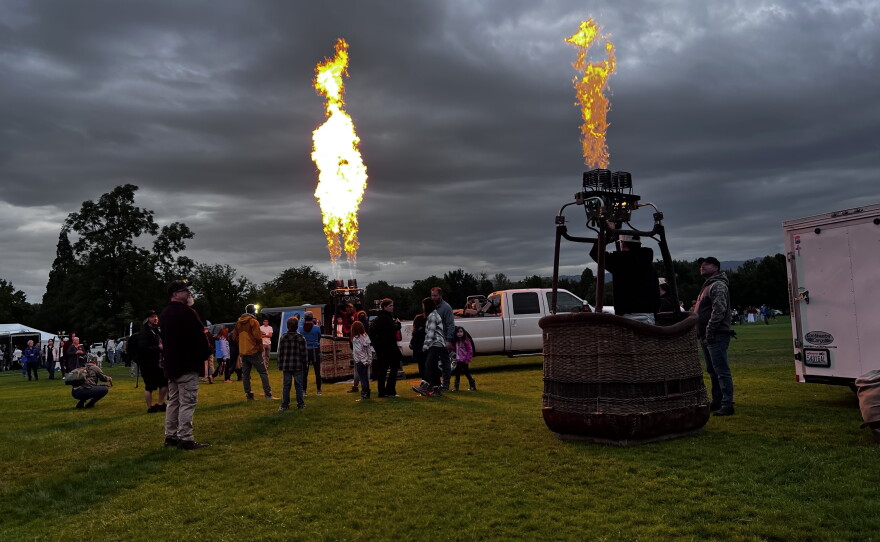
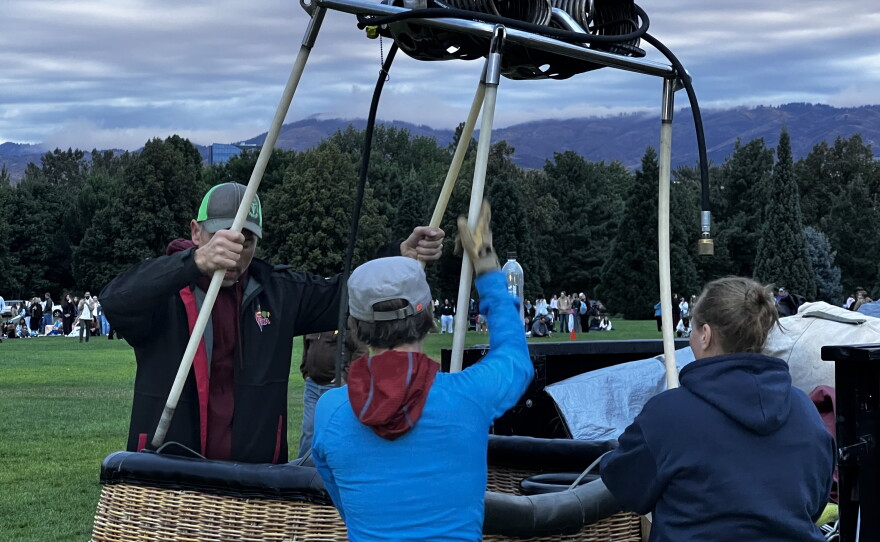
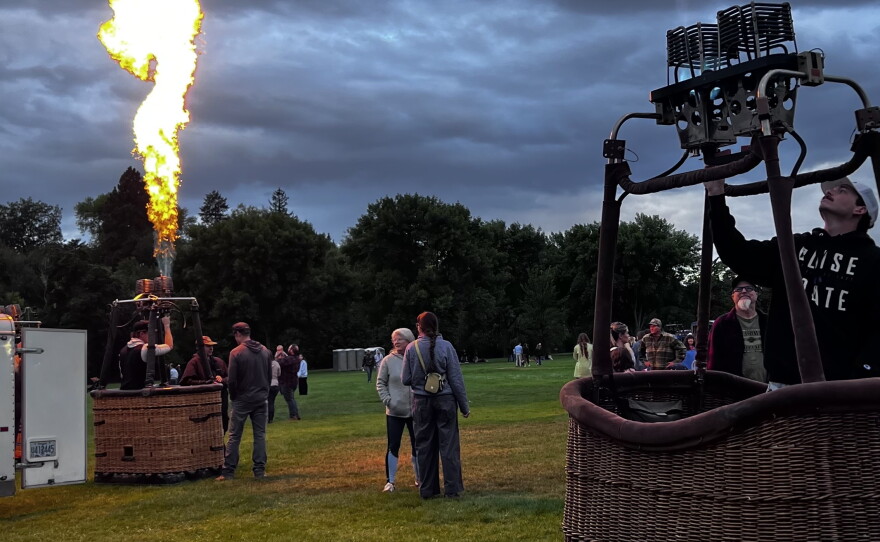
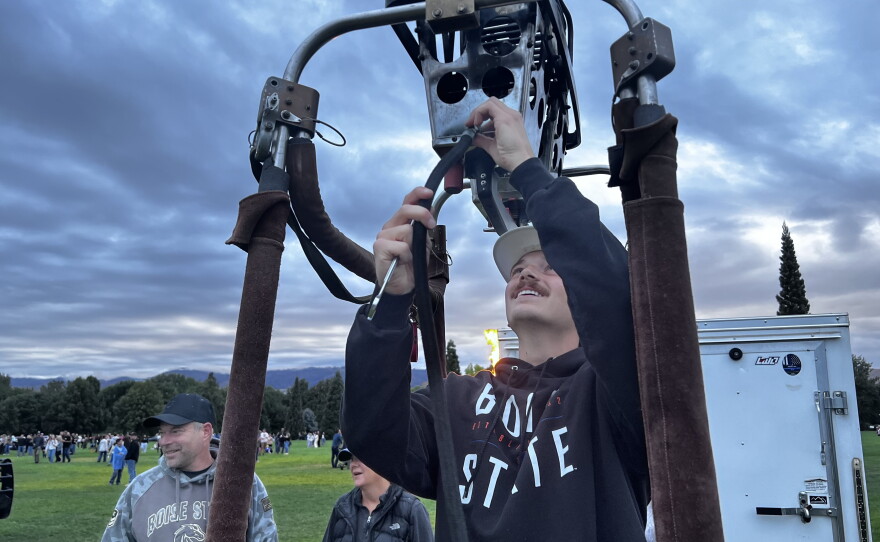
Thursday morning's wet and windy weather kept the fleet of hot air balloons grounded again, but pilots showed off their burners for the crowd and looked forward to better flying conditions starting Friday.
We spoke with one of the youngest pilots, Cooper Dill, live during Morning Edition.
Read the transcription of the conversation below.
Troy Oppie, BSPR: And it is Morning Edition on Boise State Public Radio News. We are live in Ann Morrison Park this morning. The Spirit of Boise Balloon Classic in its 35th year. We can't go into the sky this morning. We don't even have any balloons up because of the weather. Rain and winds, of course. Not friendly to hot air ballooning, but baskets are out, burners are flaring up. And I'm here with Cooper Dill, who is a pilot. Let's hear what these sound like.
Cooper Dill, balloon pilot: Yeah, here we go.
Oppie: I heard you a little bit ago telling somebody you've got about 40 gallons of propane on board here. And how long will that let you fly?
Dill: Yep. So 40 gallons of liquid propane could fly for about two hours if I wanted to usually fly, but for about an hour.
Oppie: I will be honest, I've never seen a hot air balloon baskets up close. It's a little, uh, less tall than I was expecting. It comes up to about my waist if I was inside and, uh, but this is a standard size. There's not a lot of room to move around.
Dill: Yeah, no. And I actually got a bench down in this basket, which is pretty cool. So you can sit, you can stand. Yeah. This is a standard hot air balloon for a private flight pilot plus two people.
Oppie: So Cooper Dill is our pilot. You are a recent Boise State graduate graduate. Congratulations. How did you get into hot air ballooning at such a young age?
Dill: Yeah. Thank you. So I started crewing for a company for a hot air balloon company in Washington when I was 16 years old. And the pilot said, if you buy a balloon, we'll help you get your license. So buddy and I saved up some money, bought a balloon for $9,000 and started started training.
Oppie: What goes into learning how to pilot one of these?
Dill: Yeah. So you got to learn a lot about the weather like we're dealing with today. You got to make smart decisions when to fly and when not to fly. You got to learn how to fly. So get hands on experience and you need about ten hours in a balloon to get your private license. Um, so yeah, weather learning the balloon itself.
Oppie: And what is the threshold? What's the red line for go or no go with this weather for you?
Dill: Yeah. A lot of times it's objective based on where you're flying your pilot skills here. This is urban flying. And so um, you know the lines a little bit lower because we're landing sometimes, you know, in parking lots and here in the city. And so we're not going to fly much, you know, if the winds are much faster than 7 to 10 knots.
Oppie: Uh, what's the most memorable flight you think you've taken in your, your young ballooning career?
Dill: Yeah. Honestly, I'm not just saying it, but flying here at the Spirit of Boise last year as a senior at Boise State was one of the coolest things I got to do in ballooning. Aside from that, flying in front of Mount Rainier all summer long in Washington is pretty epic.
Oppie: You have Washington plates on your trailer here. Are you from up that way?
Dill: Yep. Yeah, from 45 minutes south of Seattle.
Oppie: How how does ballooning at such a young age factor in? Because most of these pilots are, you know, they have a lot of years on you. Let's let's just say that. How does that factor into the the camaraderie among fellow pilots?
Dill: Yeah, it's super fun. The balloon community is niche, but they're all willing to help. And so last year, with it being my first time out here, I had some great pilots. Joe, Mike, Greg who showed me the area and were super kind to me. So as a young pilot, I've had nothing but great help and people helped me get into ballooning and learn new areas.
Oppie: All right. Let's talk a little bit about if we had a balloon on top of us, which we don't this morning. If you're just joining us on Morning Edition with the Spirit of Boise Balloon Classic, we don't get to fly today because of the weather and there's no balloons up. But these are very powerful burners. How long does it take to fill a balloon, and what size or capacity is that balloon that's on top of you?
Dill: Yeah. So the balloon that I fly is 90,000 cubic feet of volume inside. So if you picture a basketball is about a cubic foot or a chicken is about a cubic foot, so 90,000 chickens would fit inside of the envelope. So they're pretty massive. And it takes all that to lift this basket that is 5 to 600 pounds. Um, not including not including the passenger weight. But yeah, so we start by cold inflating the balloons. We use a big gas powered fan to fill the balloon with cold air. And then we pump it full of hot air, stand it up, and then we're using 40 gallons of propane, usually about 20 to 30 on a standard flight.
Oppie: Uh, my friends have been texting me this morning. They've already made the hot air joke so that we've got that covered, uh, for me on the radio this morning. But if you come down, if folks come down to the Spirit of Boise Balloon Classic through the weekend, you will be able to see the weather outlook is more favorable in the coming days. You should be able to see that inflating process. You should be able to see these balloons take off. You should be able to see them in the sky. If you're driving around and looking up the next couple of mornings. Cooper, thank you for your few minutes this morning. Enjoy the Spirit of Boise Balloon Classic. Hope you get up in the air in the next couple of days.
Dill: Yeah. Thank you. We'll be hoping for good weather. And then we're going to be out Friday night as well at the park doing a night glow. So that'll be cool.
Oppie: Have fun. Stay safe. Thanks again. This is Boise State Public Radio News.
Transcription generated by software and edited by a human.
