

Voter guide for the 2026 General Election in Idaho
Dates you should know:
- Tuesday, Oct. 13: Early voting can begin
- Friday, Oct. 23: Absentee ballot application deadline
- Friday, Oct. 30: Early voting ends
- Tuesday, Nov. 3: Election Day and absentee ballot return deadline
- Wednesday, Nov. 4: Voter registration reopens
- Tuesday, Nov. 24: Deadline for state board of canvassers to met and conduct the canvass of the general election
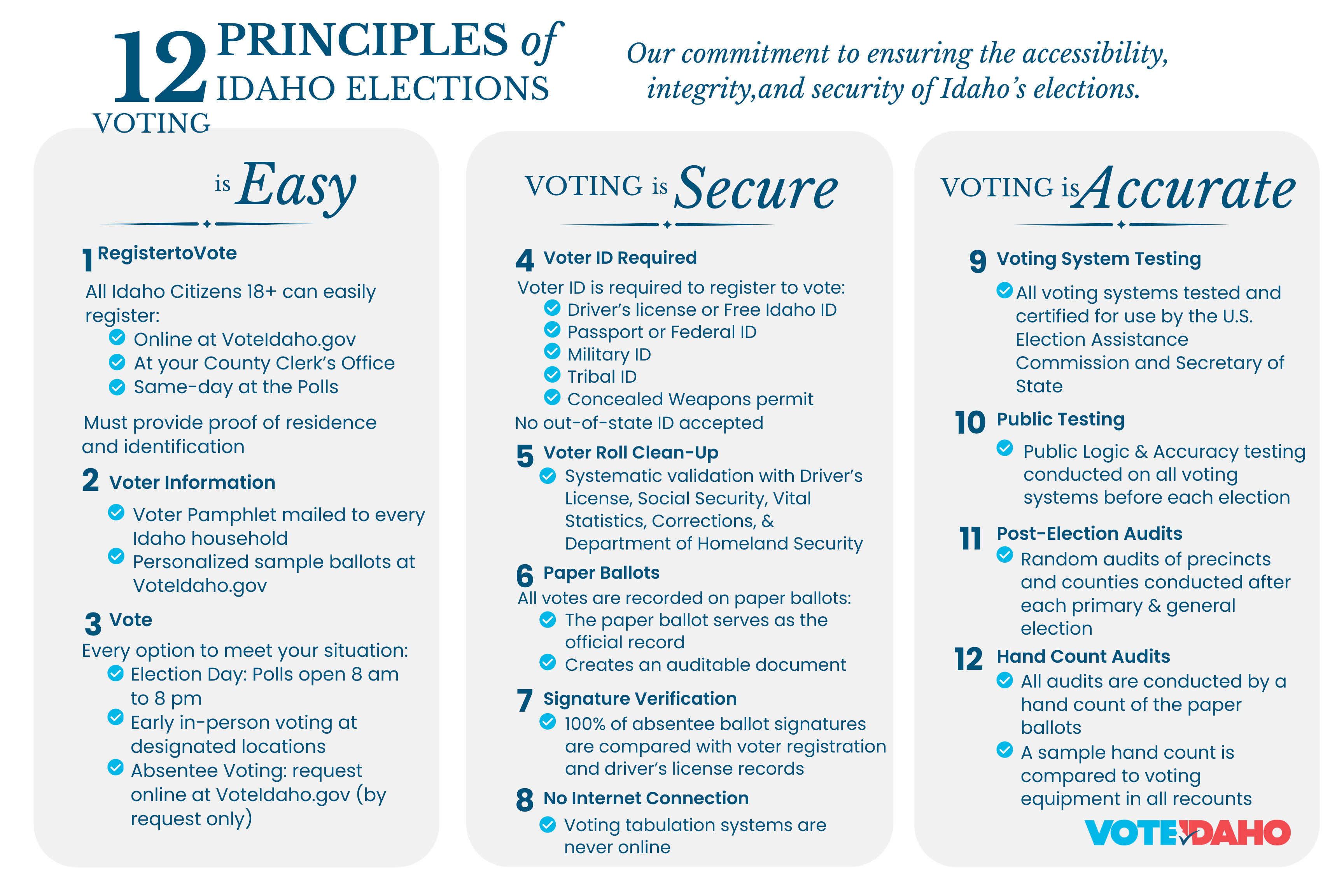
Register/Update Voter Registration
If you need to register to vote or update your existing voter registration, you can do so online or by mail.
If you are registering to vote or updating your existing voter registration online, you will need to have a Driver’s License or identification card issued by the Idaho Department of Motor Vehicles.
You can get a free identification from the DMV to use at the polls. To get the identification card, the applicant must be at least 18 years old and does not possess a valid driver's license. If the applicant does have a valid driver's license, it can be surrendered to get the other identification card.
The applicant must indicate the identification card is needed for voting purposes on the application. To get the card, bring proof of Idaho residency (like a lease or rental agreement, utility bill or school enrollment records) and proof of age and identity, like a birth certificate, passport or naturalization documents.
This identification card is the same as the standard Idaho Identification Card, just offered at no charge to eligible applicants.
If you are wanting to register to vote by mail, fill out this form and mail it to your county elections office. If you do mail it in, it must be postmarked by the 25th day before an election, and if you are a first-time voter in Idaho, a copy of current and valid photo identification and a copy of a current utility bill, paycheck, bank statement or another document that shows your name and address must be submitted with the form or shown at the polls before voting.
You can register to vote at the polls on Election Day if you miss the deadline. You will need to bring a current photo ID and proof of residence.
Online and mail voter registration reopens the day after an election.
How to vote in-person
The most important thing here is knowing where to go to vote. Your polling place may have changed and you can find your polling place online. Once you enter your home address, the website will give you your polling location and the option to email or text the directions to your voting location.
When you get to your voting location, you have to present a photo ID or sign a Personal Identification Affidavit. Polls are open from 8 a.m. to 8 p.m. on Election Day. If you have any questions on Election Day, ask a poll worker.
How to vote with an absentee ballot
You can request an absentee ballot up until 11 days before any election. You do have to be a registered voter to submit an application and you have to have an Idaho Driver’s License or State Identification Card and the last four digits of your social security number.
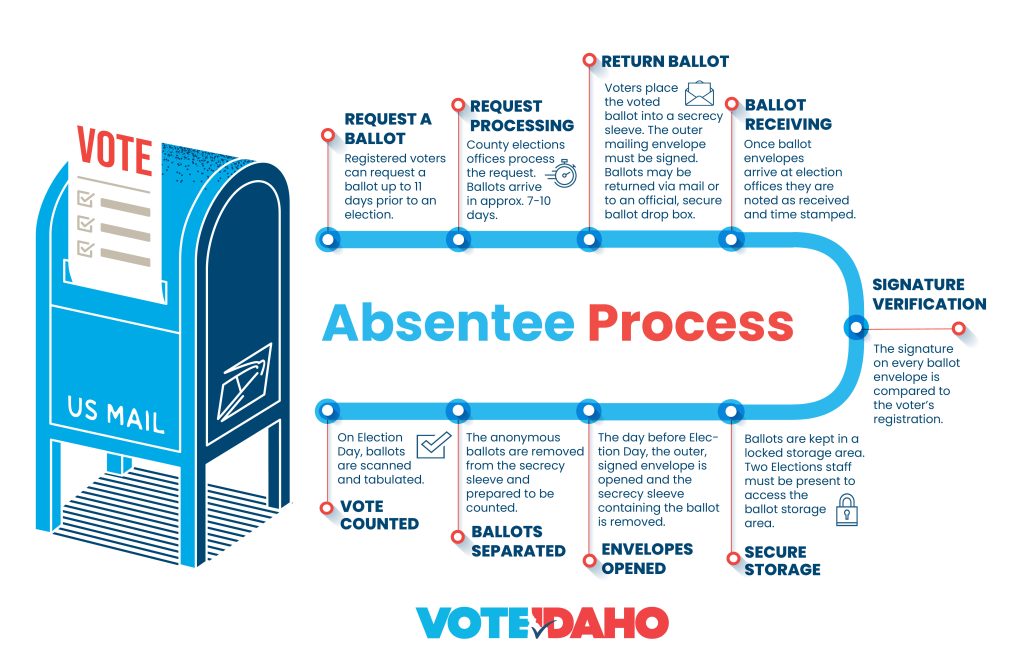
If you don’t have the required ID numbers, you need to download a paper application and mail it to your county clerk or visit your county elections office. VoteIdaho.Gov recommends you use Google Chrome to fill out the application.
You can also request an absentee ballot by mailing in a paper request form, requesting a paper form from your county clerk’s office or submitting a written request to your county clerk with the following information:
- Name
- Residence address in Idaho
- Mailing address
- Your signature
When you get your absentee ballot, make sure to fill in the rectangle completely with a blue or black ink pen and vote only for the appropriate number of candidates in each race.
Before you send in your ballot, remove the stub from the top of the ballot and put the ballot inside the yellow secrecy sleeve, then the return envelope. You have to sign the back of the outer return envelope and your signature will be verified when it is received. Envelopes without a valid signature will not be counted.
To return your absentee ballot, you can mail it but make sure to include the required postage. Ballots must be received by 8 p.m. on Election Day, regardless of the postmark date if you are mailing them in.
What's on the ballot?
Along with all 105 legislative seats, statewide offices and three congressional positions, two constitutional amendments, a question asking voters to choose the official state gun of Idaho and a proposition are on the ballot.
House Joint Resolution 4, if passed, would only allow the Idaho Legislature to have the authority to legalize marijuana, narcotics or other psychoactive substances and remove the ability for citizens to initiate state statutes that would legalize these substances. A no vote on HJR 4 opposes the constitutional amendment.
House Joint Resolution 6 would add constitutional language designating English as the official language of Idaho, if passed. The resolution would not make any changes to Idaho State Code 73-121, which designated English as the official language of the state and the sole language of the government in 2007, but it would codify English as the official state language in the Idaho State Constitution.
There’s also an advisory question on the ballot, asking voters to choose the official state gun of Idaho. The question is non-binding and will only advise the state legislature on voting preferences. The options for the state gun include:
- Winchester Model 1894 (.30-30)
- Winchester Model 1873 (.44-40)
- 1873 Colt Single Action Army Revolver (.45 Colt)
- M1 Garand rifle (.30-06)
- Colt M1911 .45 automatic Colt pistol (.45 ACP)
- Remington Model 700 bolt-action rifle (.30-06)
The legislature would need to approve the state gun in a separate law after the election. According to the National Rifle Association, as of 2026, ten states have official state guns.
Prop 1, the Reproductive Freedom and Privacy Act initiative, is also on the ballot this November.
A yes vote would create a statutory right to abortion before fetal viability, or the point when a fetus can survive outside the uterus. It would also allow abortion after viability when necessary to protect the pregnant woman’s health. The measure would establish a statutory right to reproductive freedom and privacy and provide legal protections for health care providers who provide abortion care.
A no vote would leave Idaho’s current abortion laws in place. Those laws generally prohibit abortion, with limited exceptions, including when necessary to prevent the death of the pregnant woman and in cases of rape or incest during the first trimester, when specified reporting requirements are met.