


This story contains details about a suicide, please take care while listening. If you or someone you know is in crisis, call or text 988. Find more information and resources here. You are not alone.
For the first time in the U.S., the Boise Art Museum is displaying the full work of artist Julie Green’s indictment of the American prison system. After a yearlong run, ”The Last Supper,” a powerful reflection on death and food, is open to visitors for a few more weeks.
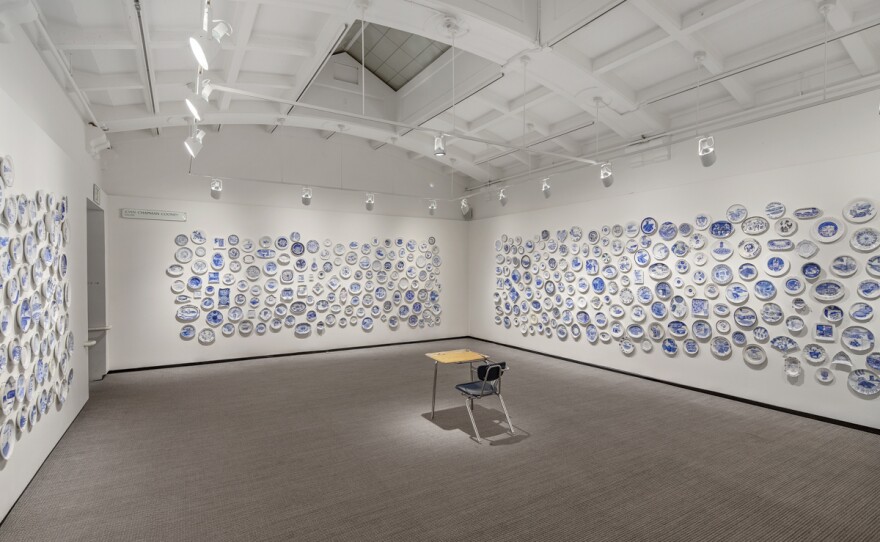
From afar, the nearly 1,000 white and blue plates adorning the Boise Art Museum’s walls look like a monumental mosaic of ancient ceramics, the kind dug up from a recently uncovered archaeological site or found in the back of a dusty china cabinet.
But up close, the mismatched dishes reveal the work of artist Julie Green: on each plate, detailed illustrations of death row inmates’ last meals. Hand-painted in blue cobalt reminiscent of 1700s Danish porcelain, the plates are filled with familiar comfort foods.
In a short documentary from the exhibit taken from the artist’s website, Green, who used they/them pronouns, read the 1999 Oklahoma newspaper clipping that sparked the idea for the project. The excerpt described a man’s last moment before dying, printed the day after his execution.
“Johnson blinked three times and let out a breath through puffed cheeks. His foot stopped shaking. His eyes slowly dimmed, became glassy, and closed to a crescent. He asked for a final meal of three fried chicken thighs, 10 or 15 shrimp, tater tots with ketchup, two slices of pecan pie, strawberry ice cream, honey and biscuits, and a Coke,” Green read.


For more than two decades, they collected news clippings of executions from across the country and started painting every final meal they could find.
“I realized that we all have food in common, that this inmate who was just executed is a person who eats and has food requests and certain foods that they like, and even foods that tell us something about where they're from and and what grows there, or [where] they grew up, or what they would like to eat, or what their mother cooked,” they explained. “You know, comfort food."
Green’s delicate brushstrokes of intimate meals painted in blue show the scale of capital punishment in the U.S.
According to the Death Penalty Information Center, the U.S. has conducted 1,651 executions, of both men and women, since the 1970s. As of October 2025, 2,100 remain on death row. NPR reports the number of executions this year are the highest they’ve been in a decade.
Green's detailed illustrations are appetizing, the inmates’ choices familiar and human, in stark contrast to their imminent state-sanctioned obliteration.
A few requested meals are extravagant: boiled crab with grits, T-bone steaks, a lobster dinner. But most are humble: a jug of Kool-Aid, Jolly Rancher candies, a bag of chips. One single honey bun.
“We really wanted to create this kind of immersive experience for people to walk into and to be a little bit overwhelmed by the work and by the idea,” said museum director Melanie Fales. The exhibit, she said, highlights how we all have special memories tied to food.
The artwork is up for interpretation, but the public is encouraged to think about their own rituals around the table.
“There's one story in which the person requested that their mother create their final meal for them, and the prison system allowed that to happen, and the mother was able to come in and create the final meal for her son,” she said. “When I think about my final meal request, I would hope that I would have the privilege of making the same kind of request.”
In 2001, Jeanne Bivins cooked chicken, dumplings and German ravioli for her son Jerry. He had been sentenced to death for killing Reverend William Radcliff at a rest stop in Indianapolis a decade earlier. Green’s painting captures the warmth of a home-cooked meal, the ravioli and dumplings are fat and plump.
After preparing his meal, Jeanne sat with Jerry in the death row visiting room and said her final goodbyes. She then went back to her hotel and swallowed 50 Xanax.
She survived her suicide attempt. Her son was put to death by lethal injection the following day.

“This exhibit was devastating,” said museum visitor Azazel Finch, taken aback by how mundane the meals seemed.
One plate of a man executed in Texas in 2007 just shows two boxes, one of Rice-A-Roni, the other of Kraft’s mac and cheese. Another depicts a lavish chocolate cake, topped with candles. It was David Leon Woods’ last meal before his May 4, 2007 execution by the state of Indiana. Prison officials brought it to him after finding out he had never been given a birthday cake before.
“You have to wonder what kind of life they lived for that to be the case,” Finch said. “Food and death are certainties. And so to be so humanized in their deaths, and even denied that humanity by certain states who would not fulfill their meal requests is ... the word for it is barbaric.”
In certain states, like Texas, death row inmates are not given special last meals. In Idaho, they can only choose from the regular prison menu.
Amid the exhibit’s wall of blue, visitors’ eyes might catch a glimpse of color. On one singular plate, Green painted in yellow what an inmate in Texas asked for his final meal: waffles covered in full-fat cream and syrup, and a strawberry milkshake.
Instead, he was served the same as everyone else in prison that day. Baked chicken, fish, boiled eggs, carrots, green beans and sliced bread.
Visitor Anna Demetriades was struck by the apparent dissonance of the prison system’s last meal practices, offering inmates’ one last indulgence before killing them.
“What is that supposed to be to them?” she said. “It feels like a form of torture to me: Like, ‘Here's something that you love, that you get one more time before we put you to death.'”
Another small plate in the exhibit depicts just a single pack of Pall Mall cigarettes.
Many others have no illustrations, only the word “None” painted a across them: artifacts of denied requests or perhaps inmates’ loss of appetite while waiting for death.
“Food and death are certainties."
In the exhibit documentary, Green said they started this work with the goal of running out of last meals to paint.
“My long term hopes for the project are that we stop having capital punishment,” they said.
“And then I stop painting plates.”
Green died in 2021. In the four years since, the U.S. has killed 101 death row inmates.
Before his botched and postponed execution by the state of Idaho last year, Thomas Creech ate fried chicken, mashed potatoes with gravy, corn, rolls and ice cream. He remains on death row.
In 2023, the firing squad became Idaho's main execution method, signed into law by Gov. Brad Little. It will go into effect in July 2026.
Correction: A previous version of this story mistakenly stated the exhibit ended its run in December. It will be open to the public until January 4, 2026.
Audio clips of Julie Green are from a 2012 short documentary taken from the late artist’s website, originally produced by Ira Chute, with music by Naim Amor.
