


Bob Kustra
About Bob Kustra
Bob Kustra is the host of Reader's Corner, a weekly radio show that features lively conversations with some of the nation’s leading authors about issues and ideas that matter today.
Dr. Kustra stepped down as president of Boise State University in July 2018 after serving for 15 years at the helm of Boise State, the largest public university in Idaho. During his presidency, he led the university in a time of dynamic growth in student enrollment, graduate college and doctoral programs, new construction, fundraising and research. The creation of the College of Innovation and Design and ranking as a doctoral research university were notable achievements of his presidency.
With a long and distinguished career in public service in Illinois, Bob Kustra served two terms as Illinois lieutenant governor following 10 years in the legislature. He also chaired the Illinois Board of Higher Education, responsible for funding and oversight of the state’s nine public universities. Bob's background in radio includes four years as host of a talk show on WLS-AM in Chicago.
Dr. Kustra holds three degrees in Political Science, including a Ph.D. from the University of Illinois, MA from Southern Illinois University and BA from Benedictine College, Atchison, Kansas.
In addition to hosting Readers Corner, Bob also writes a weekly column for the Idaho Statesman and serves on its editorial board.
About Boise State Public Radio
Boise State Public Radio is Idaho’s premiere connection to NPR news programming, classical music, and jazz. The station’s 18 transmitters and translators reach about one million listeners from Boise and Twin Falls to McCall and Sun Valley.
In the Treasure Valley, 91.5 FM is Boise State Public Radio News. Here, you’ll find NPR’s cornerstone programs like Morning Edition and All Things Considered , plus fan favorites like Fresh Air and This American Life. 91.5 FM is also home to local and regionally-produced in-depth news features and interviews.
This radio network has served the community for more than 40 years. With staff headquarters in Boise, the signals can be heard in parts of eastern Oregon, most of southern and central Idaho, and northern Nevada.
-
 Lawrence Wright takes us into the death row unit, laying bare their stories. Some of the women in prison wrestle with guilt over the suffering they’ve caused; others fiercely maintain their innocence. As Wright learns more about their cases, unethical police practices and improper forensic methods cast doubt on whether some of these women actually committed the crimes for which they’ll pay the ultimate price in his book Redemption.
-
 From the revered bestselling author, a compulsive, page-turning thriller inspired by her real life work exonerating innocents, a novel that asks how far we'll go in our pursuit of the truth--an emotionally rich, luminously written book about evil and people trying to do good in the world. Ruby Spencer is known as "the exonerator." Her job as an investigator is to free innocent men from death row, and she's good at what she does. What many people don't know is that she spends her time finding missing women, too. The orphaned daughter of an orphaned mother, Ruby feels a natural affinity for those who have been mistreated by the world at large.
-
 In Private Power and Democracy’s Decline, Mordecai Kurz explores the relationship between free-market capitalism and democracy. He shows that technology has made capitalism different from what was envisioned in the Age of Enlightenment.
-
 Note: This is an encore presentation of Reader's Corner. The episode originally aired in September 2022.An interview with Edward H. Miller, author of A Conspiratorial Life: Robert Welch, the John Birch Society, and the Revolution of American Conservatism. In the book, Miller argues that Welch’s paranoid right-wing nativism, dismissed by thinkers like William F. Buckley, gradually moved from the fringe into mainstream conservatism.
-
 The extraordinary true story of the Afghan women judges who fought for justice in the courtroom, and then fought to escape with their lives, from the bestselling British author Karen Bartlett
-
 The Return of the Oystercatcher: Saving Birds to Save the Planet by Scott Weidensaul As populations fall and once-great migration multitudes wither away, the future of birds may seem grim. But surprisingly, from gnatcatchers and waterfowl to select groups of forest songbirds, some bird populations are soaring. Habitats and species that once neared extinction are now multiplying around the world because bird conservation is making things better.Because birds are so diverse, so ubiquitous, and cover virtually every square mile of the Earth’s surface, the fight to save the birds is also one to save the world. The Return of the Oystercatcher is an inspiring story of what’s working in bird conservation―and what can work for the rest of the planet.
-
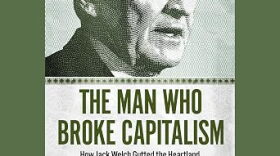 (Encore from November 15, 2024): New York Times reporter and "Corner Office" columnist David Gelles reveals legendary GE CEO Jack Welch to be the root of all that's wrong with capitalism today and offers advice on how we might right those wrongs.
-
 Our guest is one of Russia’s top investigative journalists, working and living in exile. In his latest book, co-authored once again by his fellow investigative journalist, Irina Borogan, Our Dear Friends in Moscow follows a group of young Russians, part of an idealistic generation who came of age in Moscow at the end of the 20 th century – the communist era had just imploded and an exciting and uncertain future lay ahead of them. Initially, the group enjoyed the freedoms of the new era, but the notion that Russia was destined to join the West, and Europe, in a new partnership began to fade. The Russian economy crashed, civil war stalked Chechnya, and terrorism came to Moscow. By the time of Vladimir Putin’s second and seemingly endless term as president, the country had embraced a kind of ethno-nationalism and was heading for war at home and abroad.
-
 For nearly eight decades, North Korea has marched defiantly to its own beat, shaking off its Soviet and Chinese sponsors to emerge as the world’s most enigmatic nation—a nuclear-armed state ruled by a dictatorial dynasty. Underpinning the state is a personality cult more soaked in religiosity than those constructed by Stalin or Mao—one that traces its roots back to the Christian fervor of post–Civil War America.
-
 The diversity principle – the idea that people with different backgrounds, identities, and viewpoints produce better work – was a core tenet of the first modern research university and the inspiration for John Stuart Mill’s classic treatise, On Liberty. But as a war on diversity upendsgovernment, corporate, and education policies, the history of the idea of diversity has never been more important. In his latest book, The Diversity Principle: The Story of a Transformative Idea, David B. Oppenheimer, a diversity skeptic turned believer, chronicles how diversity became a foundation of education over the last 200 years, how it evolved in commerce and science, and the inevitable implications of the current backlash.


